

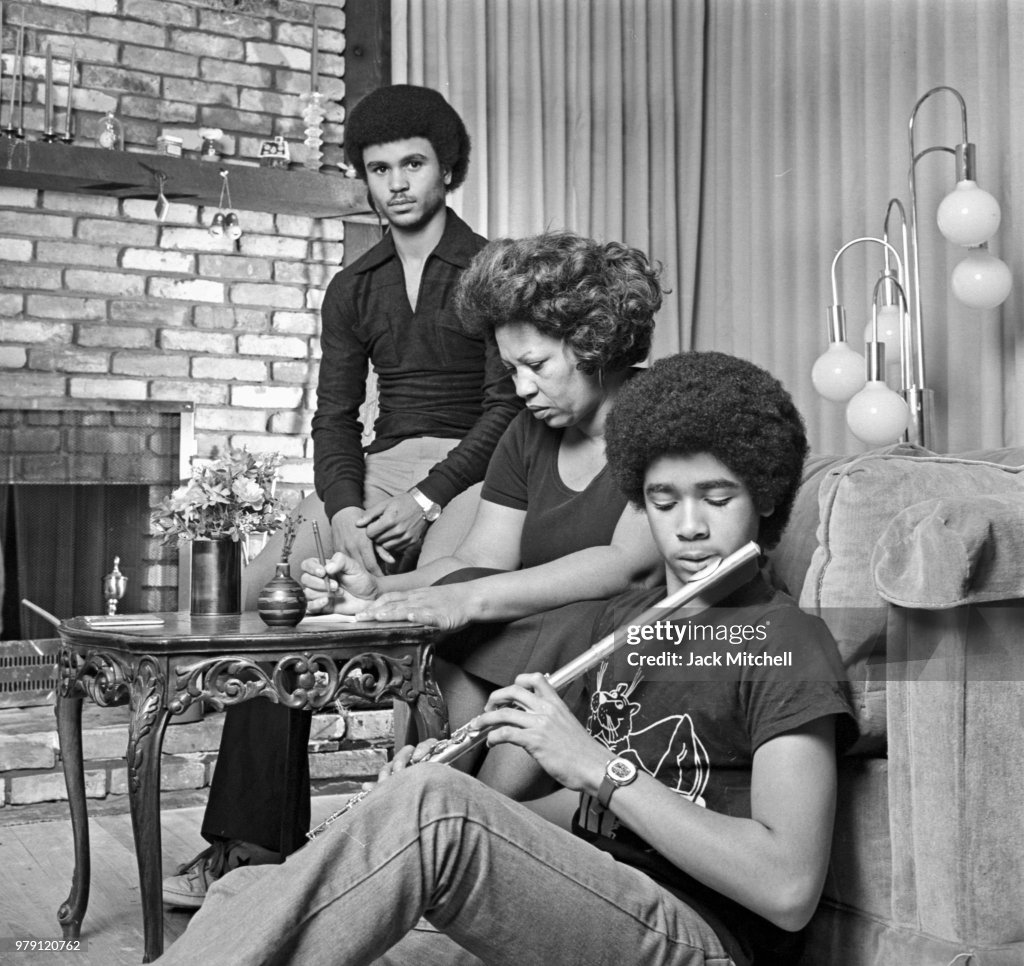
**Title Image (Novelist Toni Morrison Discusses Playwriting) sourced from Getty Images **
Language creates.
Start.
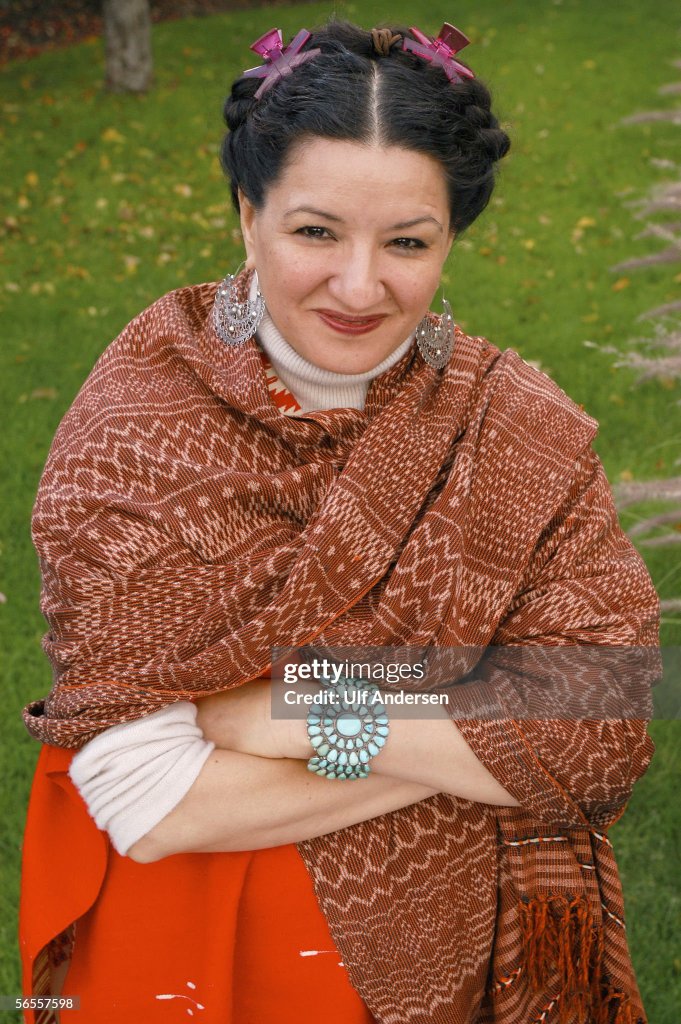
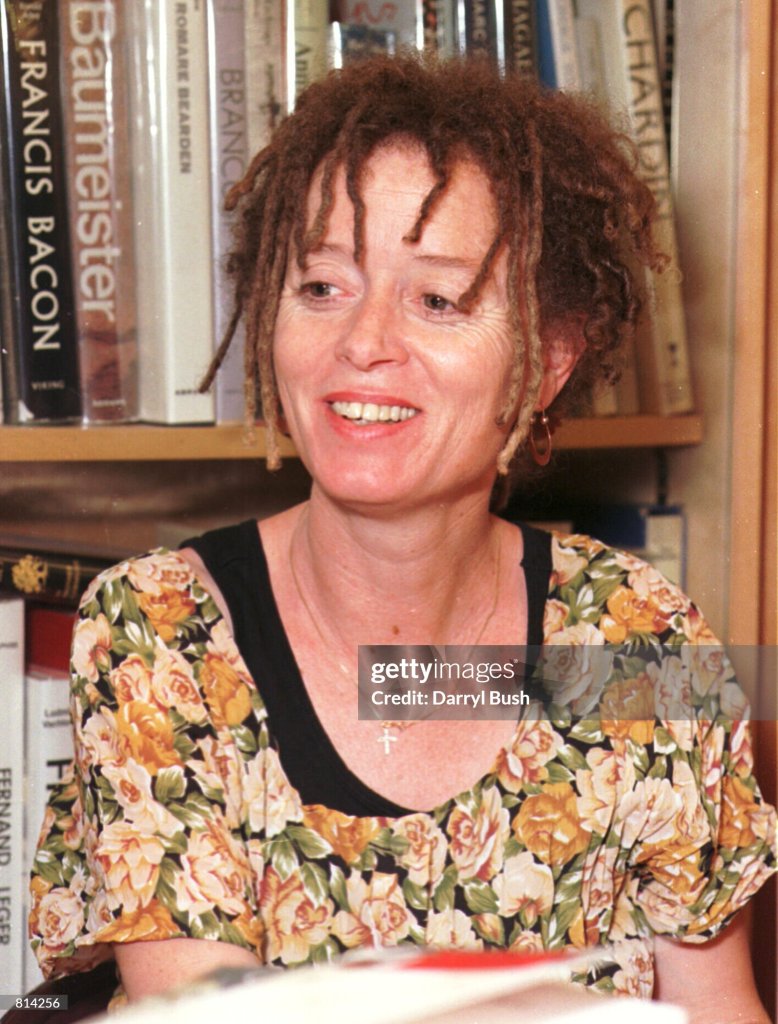
There is an unusual little girl sitting in her room right now, reading a book. She will spend most of her elementary years reading books, instead of talking to friends. When author of The House on Mango Street (1983), Sandra Cisneros, looked back upon moments where she was left to herself during childhood, she notes, “that aloneness, that loneliness, was good for a would-be writer – it allowed me time to think and think, to imagine, to read and prepare myself.” (“Only Daughter”). Before I started writing for myself, many efforts made to silence my ideas slipped past me or went over my head, because I couldn’t see the narrative of my life.
In 1993, during her Nobel lecture, Toni Morrison offered reflections on the magic of language. Toni Morrison used language to create spaces meant for understanding through storytelling, and in my own life I see the language of storytelling as a power that gives words to uniquely personal revelations too complex to discuss right away.
Discussing Discrimination Through Narrative
Discrimination, like a cockroach in the summertime, breeds. One of the beautiful things about Toni Morrison’s Nobel Lecture is that she used many poignant words that could have been used to describe racism, but instead chose power as the literal subject. Certain passages in her lecture describe language as it was seen by the wise old blind woman of the story. The oracle keenly knew that language was “given to her at birth, is handled, put into service, even withheld from her for certain nefarious purposes,” (Morrison). Toni Morrison held the properties of language sacred and fragile in her mind. Unarmed, this metaphorical language linked together something people have always known: a feeling of loss; the sting of having something, innately theirs, stolen or taken away. Humans know the depth of emotion rooted in the movements of power. In research investigating the correlation of confession and health, James W. Pennebaker and Joshua M. Smythe concluded in their book, Opening Up By Writing It Down: How Expressive Writing Improves Health and Eases Pain, that “[by] talking or writing about a secret experience, we are translating the event into language. Once it is language based, we can better understand the experience and ultimately put it behind us,” (11). I define language-based ideas as thoughts and ideas that are given access to the tools of the narrative, or the linguistic effect of language. When met with “statist” or “policing” language, the magical properties of language are “[susceptible] to death, erasure; [and] certainly imperiled,” (Morrison). Morrison was very clear in her lecture that an act of censorship shares the same breath as an act of oppression. Language bridges thoughts to meaning, but does not, by itself, create understanding. So, Ms. Toni Morrison told a story about the contagion of power, swept into sex, race, religion, government, media, and academia. Toni Morrison was the first African American, Black woman to receive the Nobel Prize in Literature (“Toni Morrison: The Life of a Literary Giant”), and in her speech she said, “language designed for the estrangement of minorities, hiding its racist plunder in its literary cheek – it must be rejected, altered and exposed.” Morrison referenced this “rousing language” that estranges when detailing the ways in which society abandons language in the face of oppression (“Toni Morrison’s Nobel Lecture”). Words spoken daily will be seen as Morrison described, as “evacuated language… with no access to what is left of…human instincts for they speak only to those who obey, or in order to force obedience.” However, the alternative to a language forced out of obedience provides new spaces, pure with inspired action and freed from oppression. Safe spaces for the mind and the tongue provide a judgment-free ear, if not always an understanding one.
“Where the intelligence of rural prophets is the source of much amusement,”
Toni Morrison’s Nobel Lecture
What Resonates?
Impact is earned, not given. Impact requires some level of understanding I think, whether it be felt through kinship to the person speaking, the act of resonating with messages spoken, or a desire to know the esoteric secrets hidden behind the new words before you. I resonate with the thought that I live “where the intelligence of rural prophets is the source of much amusement,” (“Morrison’s Nobel Lecture”), but prophet is translated into artist in my mind. Whenever there is room for interpretation, it feels as though there is room for conflict, misunderstanding, and fear of the unknown. There are many barriers around the truth found within “statist language…[with] no desire or purpose other than maintaining the free range of its own narcotic narcissism,” (Morrison PAR 11). Morrison was confident that once control is enforced, the seductive scent of slavery will keep most heads down in obedience. Often, myself, I find it difficult to bring forward words that represent the feelings that arise when reflecting on the harsh realities surrounding me. Maybe because, “[if] we don’t talk about a powerfully emotional experience with others, it’s almost impossible to organize it in our minds in a broad and integrative way… we don’t translate the event into language. This can prevent us from understanding the event.” (Pennebaker and Smyth 11). “But try.” (Morrison). We do not choose what happens to us, but we can choose how we share our stories through language.
“Passion is never enough; neither is skill. But try. For our sake and yours, forget your name in the street; tell us what the world has been to you in the dark places and in the light.”
Toni Morrison’s Nobel Lecture
But Try.
Toni Morrison said that the process of transforming language into narrative for the purpose of: reaching towards ineffable, painting a memory, or creating meaning in humanistic differences is sublime (Morrison)– and that sentiment was what I was missing. Once I was able to look at my thoughts, I could see that I was not articulating them in life as well as I was able to on the page. “Passion is never enough; neither is skill. But try. For our sake and yours, forget your name in the street; tell us what the world has been to you in the dark places and in the light,” (“Toni Morrison’s Nobel Lecture”). When Morrison spoke from the point-of-view of the children in her story, she used direct language and ethos to persuade. Morrison emphasizes this by placing a conjunction at the start of a sentence, “But try.” The children are challenging the wise old blind woman by stating what they think best embodies their shared beliefs. Challenging her silence to disagree with the idea that what the curious and unrelenting mind wants is the effort to try. Stories hold mysterious power, and depending upon their wielder can bring people together, divide them, and even create something new.
Liking the article? When you’re finished reading, you might wanna check out Episode Two of Season One of Enhance Podcast! Listen to Samm and his friend Morgan discuss identity, discrimination and self-expression in their workspace and community .

Perfectionism: The Sleeper Agent of Self Sabotage
You cannot take language away from someone else without killing your own voice. Anne Lamott stated in her book, Bird By Bird, that “perfectionism will ruin your writing, blocking inventiveness and playfulness and life force.” (28). When we are hurt we shut ourselves off “[to] keep us from getting hurt in the same place again, to keep foreign substances out. So those wounds never have a chance to heal.” (Lamott 30). One of my acting professors, Carter Gill, told my class, at the beginning of our freshman year in our BFA program, that we must embrace the fact that fear will never go away, and that all we can do is “be louder than your critic and faster than your fear.” Essentially, “[y]ou need to start somewhere.” (Lamott 25). Start and suddenly the choices appear. “If it is dead, you have either found it that way or you have killed it. If it is alive, you can still kill it. Whether it is to stay alive, it is your decision. Whatever the case, it is your responsibility,” (“Toni Morrison’s Nobel Lecture”).
But start.
In conclusion, when judgment lies in bed with language it kills the speaker’s life and causes humans to act in desperate ways. When we seek to use language for nefarious purposes (Morrison), we take away the life-giving properties that language provides and foster perfectionism. “Perfectionism is the voice of the oppressor, the enemy of the people. It will keep you cramped… and it is the main obstacle between you and a shitty first draft.” (Lamott 28). What will be the first draft of the story that you tell? Does it, as Nigerian poet Ijeoma encourages, “Start with hand shaking[?] Start with voice trembling” (Umebinyuo)? Does your story “ride solely on [your] difference from them, a difference they regard as a profound disability,” (Morrison)? Because some of the best stories do. But start. Toni Morrison found a spark of the magic lying in stories that dig past painful surfaces to reach for understanding. In her Nobel lecture, she contended that no story is singular; that the human story holds a myriad of shared narratives splintered across journeys of the soul. I see language as magic, and I think Toni Morrison did too.
This article was written by Enhance team member Sidney Floyd-Armstrong. Be sure to subscribe and keep an eye on the blog for more fun content from our team!
Works Cited
Atari, Bayan. “Toni Morrison: The Life of a Literary Giant.” The Dig, Howard University, 5 July 2022. thedig.howard.edu/all-stories/toni-morrison-life-literary-giant. Accessed on 29 November 2023.
Cisneros, Sandra. “Only Daughter.” Glamour Magazine, 1990. Latina: Women’s Voices From the Borderlands, edited by Lillian Castillo-Speed, New York: Touchstone/ Simon &Schuster, 1995. Weebly. chawkinsteaching.weebly.com/uploads/1/2/9/7/12977279/only_daughter.pdf Accessed on 29 November 2023.
Lamott, Anne. Bird By Bird. 1st ed., Knopf Doubleday Publishing Group, 1995, pp. 16-20.
Morrison, Toni. “Toni Morrison – Nobel Lecture.” NobelPrize.org. Nobel Prize Outreach AB 2023. 7 December 1993. nobelprize.org/prizes/literature/1993/morrison/lecture/. Accessed on 27 November 2023.
Pennebaker, W. James and Joshua M. Smyth. Opening Up By Writing It Down: How Expressive Writing Improves Health And Eases Emotional Pain. 3rd ed., The Guilford Press, 2016, pp. 01-12.
 Enhance Productions
Leave a comment